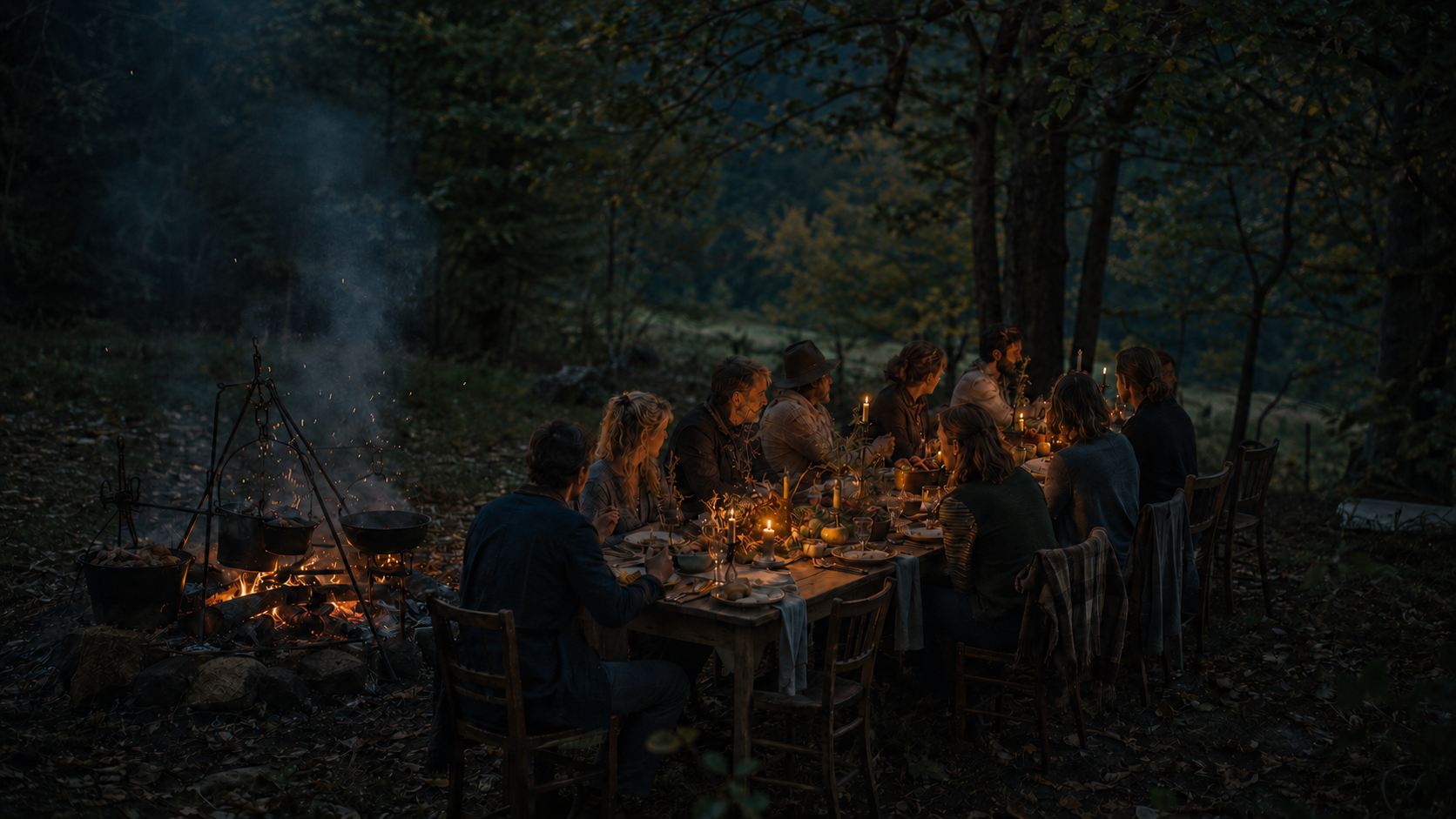
An evening at The Hidden Table is experienced through more than taste. Follow the scent of woodsmoke into the trees and discover how fire, food, land, and season awaken the senses—and create a feeling of connection that remains long after the table disappears.
The first sign is smoke.
It rises above the trees in a pale ribbon, carrying the scent of split wood, warming earth, and something already beginning to cook. The exact location may have remained a secret until recently, but the fire tells you that you have arrived.
A path leads away from the familiar world. Gravel gives way to grass. Conversation becomes quieter. The air feels different here—cooler beneath the trees, warmer near the clearing, fragrant with whatever the land is offering in this particular season.
Ahead, a long table waits.
Ten places. Linen moving slightly in the breeze. Glassware catching the last light. A few branches, herbs, blossoms, or fallen leaves gathered from the surrounding landscape. Nothing separates the table from the place where it stands. It belongs here, at least for tonight.
This is where the evening begins.
The Sight of the Table
Before the first course is served, the eyes begin to feast.
Firelight moves across faces and plates. Flames fold around dark iron, illuminating the hands tending them. Smoke drifts through shafts of evening light. Vegetables blister over coals. Sauces glisten. Bread develops a burnished crust. A cook lifts a lid, and steam briefly obscures the view.
Beyond the table, the land provides the backdrop: an orchard in blossom, a summer meadow, a woodland turning toward autumn, or bare winter branches silhouetted against the sky.
The setting is never incidental. It shapes the colors on the table, the ingredients on the plates, and the pace of the evening.
As daylight fades, candles and lanterns begin to glow. The landscape that first felt expansive draws inward. Ten guests become a small circle of light in the darkness.
For a few hours, this table feels like the only table in the world.
The Sound of Gathering
At first, the fire does most of the talking.
Wood settles into embers with a low crack. Fat touches hot iron and answers with a sizzle. A knife meets a wooden board. Glasses touch in a quiet toast. Wind moves through leaves, or rain taps against the roof of a barn prepared as shelter.
Then come the voices.
Introductions become stories. Strangers discover shared places, mutual interests, familiar disappointments, and unexpected hopes. Laughter rises from one end of the table and travels to the other. Someone asks about an ingredient. Someone else remembers a meal from childhood.
There is no need to manufacture conversation. The table does its ancient work.
Even the pauses become comfortable. There are moments when everyone is eating and nothing needs to be said. The fire fills the silence, and the silence feels generous rather than empty.
The sound of the evening is not entertainment performed for an audience. It is the natural rhythm of people becoming present to one another.
The Scent of Fire and Season
Long before food reaches the mouth, it arrives through scent.
Woodsmoke clings lightly to the air and to clothing. Herbs release their oils when crushed between fingers. Onions soften in a pan. Fruit caramelizes near the coals. Stock, wine, earth, char, butter, and rain mingle in ways that cannot be recreated beneath fluorescent lights.
Every season has its own fragrance.
Spring smells green and newly awakened: damp soil, tender herbs, apple blossoms, young garlic, and smoke rising into cool air.
Summer carries ripe tomatoes, warm grass, stone fruit, basil, and the faint sweetness of a fire burning beneath an open sky.
Autumn brings fallen leaves, mushrooms, roasted roots, cider, and hardwood smoke—a scent that feels almost like memory.
Winter is sharper and more elemental: cold air, evergreen, simmering broth, charred brassicas, spice, and the deep comfort of a fire that is no longer atmosphere but shelter.
Scent binds the food to the land. It allows the season to enter the body before the first bite is taken.
The Touch of the Evening
The Hidden Table is felt in small, physical ways.
A cool glass rests in the hand. A linen napkin settles across the lap. The grain of the table remains perceptible beneath a palm. Warm bread is torn and passed. A ceramic bowl radiates heat. The night air brushes exposed skin while the fire warms one side of the face.
There may be uneven ground beneath your feet or a path that asks you to walk slowly. The chair may be simple. The weather may make itself known.
These are not imperfections to be removed from the experience. They are reminders that the evening is happening in a real place rather than in a controlled imitation of one.
The land has texture. The season has temperature. Fire has weight and consequence.
To feel these things is to become more awake.
The Taste of Place
Then the meal begins.
Fire transforms each ingredient differently. It blackens an edge, concentrates sweetness, softens what was firm, and gives smoke permission to enter. It leaves evidence of the cooking—the beautiful irregularity of blister, ash, caramelization, and char.
But fire is not used as a performance or applied as a flavor to everything. It is a tool, a source of warmth, and a connection to one of the oldest ways people have gathered to prepare food.
The menu follows the land and the season.
What is growing nearby? What has just been harvested? What can be preserved from an earlier month? What does the weather make the body long for tonight?
A spring supper might taste of peas, greens, young onions, lamb, herbs, and orchard blossoms. Summer may arrive through corn, tomatoes, berries, smoke, and cold drinks beaded with condensation. Autumn offers squash, apples, mushrooms, game, and sauces with depth. Winter calls for roots, braises, preserved fruit, dark greens, warm bread, and food that restores.
Each course is not merely served in a landscape. It emerges from one.
The guest tastes the ingredient, the fire, the decisions of the cook, and something of the place itself.
The Sense Beyond the Five
There is another sense at work around the table—one that cannot be located in the eyes, ears, nose, fingertips, or mouth.
It is the feeling of belonging.
It begins with being expected. A place has been set. Dietary needs have been remembered. A drink is offered. A name is spoken. Someone is genuinely glad that you made the journey.
The evening does not ask you to perform. There is nothing to understand correctly and no role to play. You are invited simply to arrive, become curious, and share the table.
As dishes pass from hand to hand, the boundaries between host, cook, guest, and place begin to soften. The meal becomes communal. Conversation becomes part of the experience rather than something occurring beside it.
This creates connection—not the hurried exchange of a crowded restaurant, but the slower recognition that everyone present has chosen to come to this place, on this night, for something that will never happen in quite the same way again.
The land grounds the gathering. Fire holds its center. Food gives it form. The season reminds everyone that the moment is temporary.
Perhaps that is why it feels so valuable.
Nothing here is permanent. The table will be cleared. The fire will settle into ash. The candles will be extinguished. By morning, the clearing may offer little evidence that dinner ever occurred.
But something remains.
Smoke lingers faintly on a coat. A flavor returns unexpectedly the next day. A stranger’s story is remembered. The image of the table glowing beneath the trees becomes part of an inner landscape.
You leave feeling restored—not because the evening allowed you to escape the world, but because it returned you to something the world too often obscures.
The warmth of a fire.
The character of a place.
The honest taste of a season.
And the knowledge that, for one evening, there was a place at the table waiting for you.
“An evening at The Hidden Table is not simply tasted. It is heard, touched, inhaled, watched, and felt.”← Back to journal & blog